
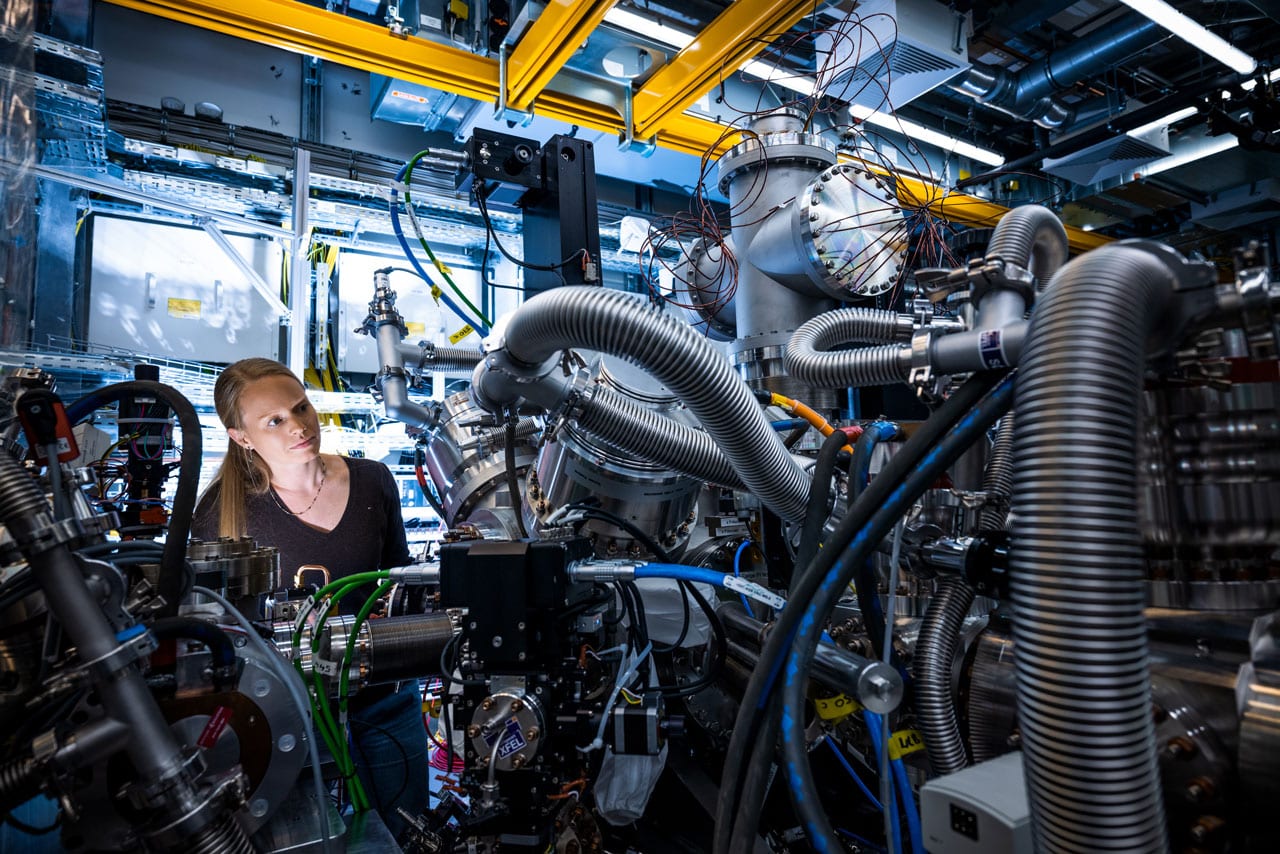
A research facility of superlatives is located in the Hamburg metropolitan region: the European XFEL generates ultra-short laser light flashes in the X-ray range - 27,000 times per second and a billion times more intense than the best conventional X-ray sources. The facility opens up completely new research opportunities for science and industry. As the main shareholder, DESY is heavily involved in the operation of the X-ray laser.
Films of chemical reactions that take place in fractions of a second. Images of proteins in which every atom can be seen. Images of nanomaterials in which the finest details can be seen. Or insights into the states of matter that exist inside giant planets or stars. The European XFEL X-ray laser makes such experiments possible.
A major international project
The European XFEL, which is located in underground tunnels, is over three kilometers long and extends from the DESY site in Hamburg to Schenefeld in Schleswig-Holstein, where the research campus with a large experimental hall is located. The billion-euro project is an international undertaking for which a separate company, European XFEL GmbH, was founded. In addition to Germany, eleven other countries are involved.
DESY is the main shareholder and works closely with European XFEL to operate the facility. Together with international partners, DESY has built the heart of the X-ray laser facility - the 1.7-kilometer-long superconducting accelerator with the electron source, which DESY now also operates. The accelerator is based on the superconducting TESLA technology developed by DESY and its partners as part of the TESLA Technology Collaboration. With the FLASH free-electron laser, DESY has been operating a 300-meter-long prototype of the European XFEL since 2005, which is based on the same technology.
Unique insights into the microcosm
Scientists from a wide range of disciplines use the superlaser: In the life sciences, it provides detailed images of cell components, individual protein molecules and viruses. The results help in the fight against disease and the targeted design of drugs. In chemistry, researchers can film reactions and see how individual atoms react with each other as if in slow motion. This knowledge can be used to optimize industrially relevant catalysts, for example.
In physics and materials science, the investigations help to study the exact structure of nanomaterials - important materials for the future, for example for more effective solar modules and fuel cells as well as for future data storage. In astrophysics, researchers take a close look at extremely hot and highly compressed samples of matter. This enables them to learn what it looks like inside stars and planets and to what extent fusion processes are suitable as a new source of energy.
Contact us

© European XFEL
Dr. Bernd Ebeling
Group Manager, Press Spokesman
© European XFEL