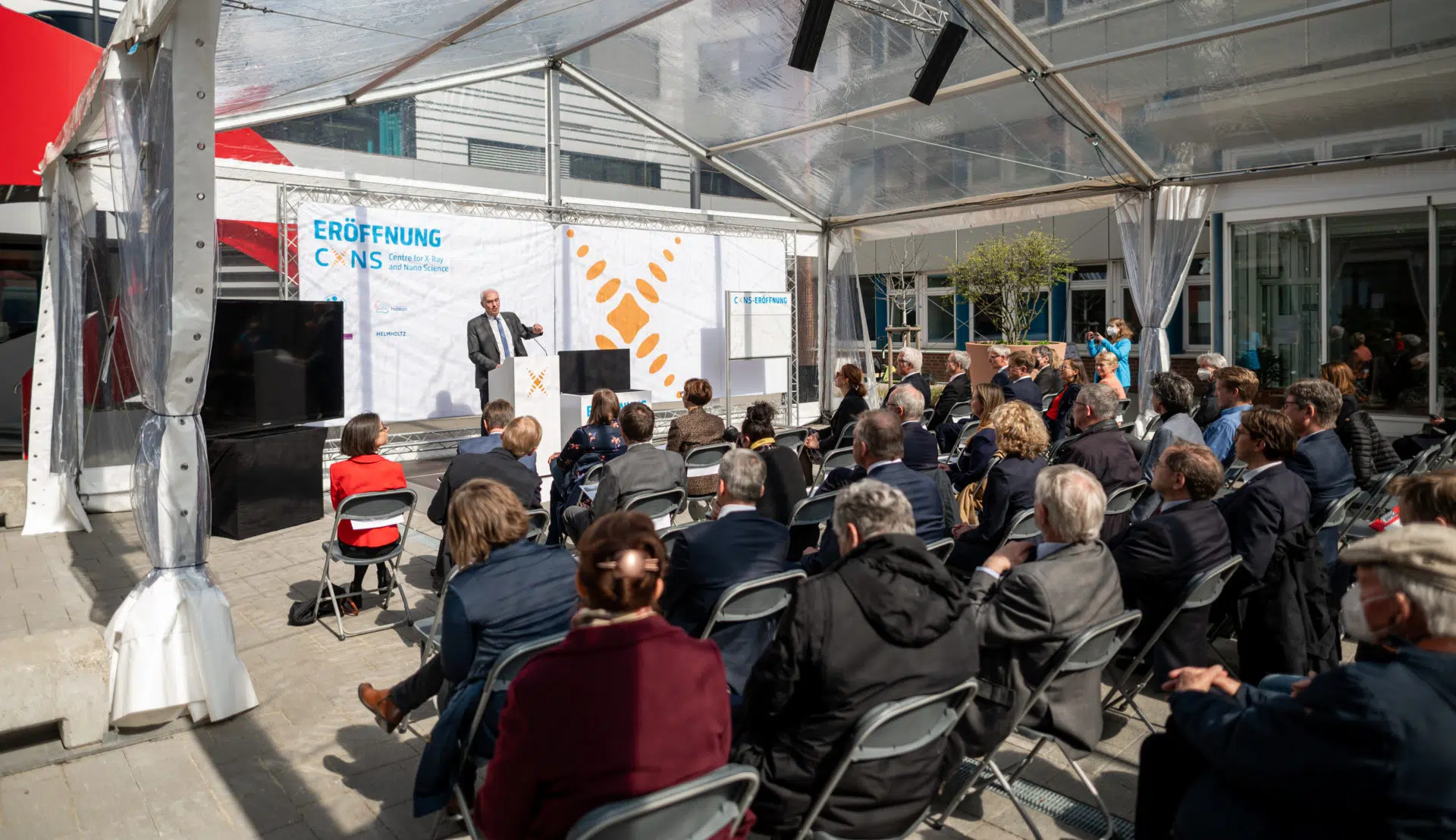
The Center for X-ray and Nano Research CXNS on the DESY research campus is an interdisciplinary, multi-institutional platform for research with X-ray light in combination with nano and material sciences and is unique in this form. Federal Research Minister Bettina Stark-Watzinger, Hamburg's Science Senator Katharina Fegebank and Schleswig-Holstein's Education Minister Karin Prien opened the new transnational research building on Tuesday, April 12, 2022 together with the President of Universität Hamburg, Prof. Hauke Heekeren, the President of Christian-Albrechts-Universität zu Kiel, Prof. Simone Fulda, the Scientific and Technical Director of the Helmholtz-Center Hereon, Prof. Matthias Rehahn, and DESY Director Prof. Helmut Dosch. Among other things, the center benefits from its proximity to the high-brilliance X-ray source PETRA III and will also provide a home for further collaborations.
The new five-storey building has a floor area of over 5,000 square meters, more than 700 square meters of which is laboratory space. It offers space for around 250 employees. The CXNS houses the DESY NanoLab, the "German Engineering Materials Science Centre" of the Helmholtz-Zentrum Hereon, parts of the "Ruprecht Haensel Laboratory" of the Christian-Albrechts-Universität zu Kiel as well as a cooperation between DESY and the TU Hamburg as part of the interdisciplinary "Center for Integrated Multiscale Materials Systems" and a branch of the Leibniz Institute for Crystal Growth.
Other working groups at DESY Photon Science also use laboratories and office space in the building. The CXNS offers ideal conditions for nano and materials research with photons and complementary methods. High-tech laboratories with complementary, networked analysis and research methods are concentrated in one place and directly connected to the DESY large-scale research facilities.
The approximately 18 million euros for the building come from federal funds, the participating states of Hamburg and Schleswig-Holstein and from the basic budgets of the three participating research institutions.
Bettina Stark-Watzinger, Federal Minister of Education and Research: "Basic research investigates the fundamental questions of our world and is constantly discovering new things. It creates knowledge that flows into our innovation pipeline, which we so urgently need in order to be able to tackle major challenges such as pandemics or climate change. The CXNS is an unparalleled research center. The federal government has contributed more than 15 million euros to the total investment for the construction. We are strengthening the location and laying the foundations for an effective and internationally leading regional innovation ecosystem. The proximity to the DESY start-up landscape should also ensure that ideas from research are brought into application more quickly."
Katharina Fegebank, Senator for Science: "I am delighted to be able to inaugurate another jewel for our Science City Hamburg Bahrenfeld with the Center for X-ray and Nano Science. The center offers a state-of-the-art laboratory infrastructure and will undoubtedly produce groundbreaking innovations. There are already fascinating approaches, for example in the field of hydrogen storage, which could be real game changers in the energy transition. And this is just the beginning. Science City Hamburg Bahrenfeld offers ideal conditions for this valuable cooperation between research institutions. We can be sure of this: Once again, cutting-edge research is being conducted here in Hamburg as a science hub!"
Karin Prien, Minister for Education, Science and Culture, Schleswig-Holstein: "Ideas are being developed and put to the test here that we can use to shape the world of tomorrow. The highly developed measurement processes at the DESY campus provide the best conditions for creating breakthroughs for new materials. Materials that will help us to overcome the challenges of the future. The CXNS is a place of international cooperation. And this makes it clear: in order to be able to exploit scientific potential, we will continue to need cosmopolitanism and cooperative thinking in the future."
Prof. Dr. Helmut Dosch, Chairman of the DESYBoard of Directors: "With the combined expertise of DESY, Hereon and CAU, CXNS will be a unique platform for the development and investigation of new materials, new sensor technologies and catalyst materials for chemical processes. In this way, we are creating solutions for important topics that our society so urgently needs and laying the foundations for the innovations of tomorrow."