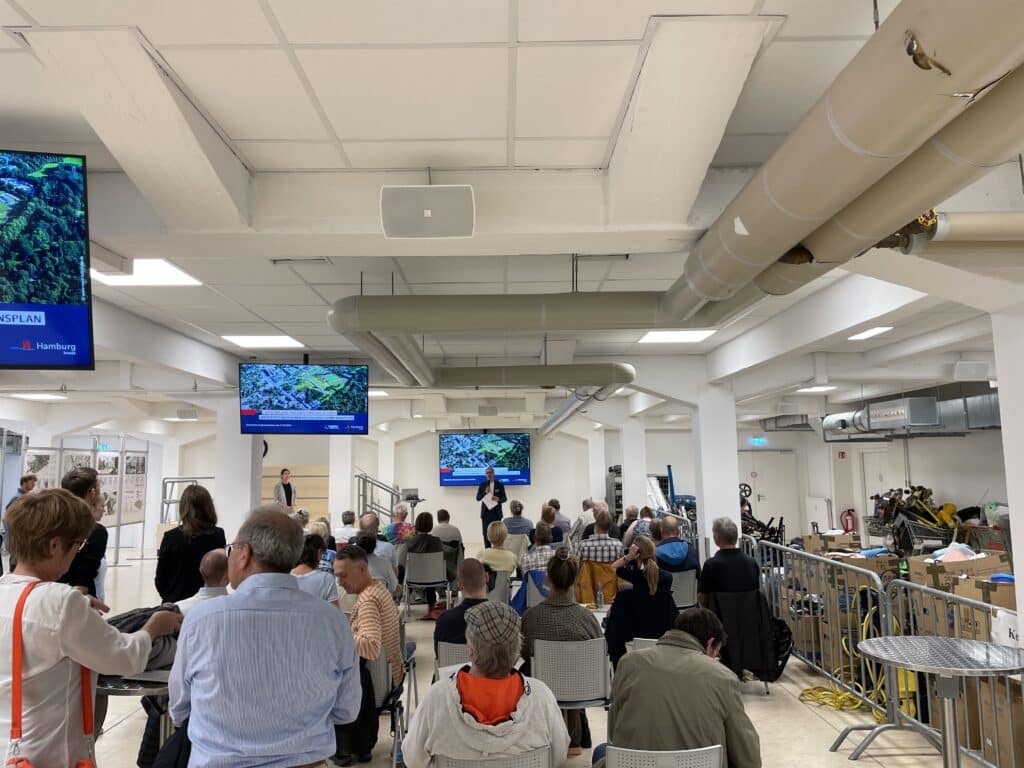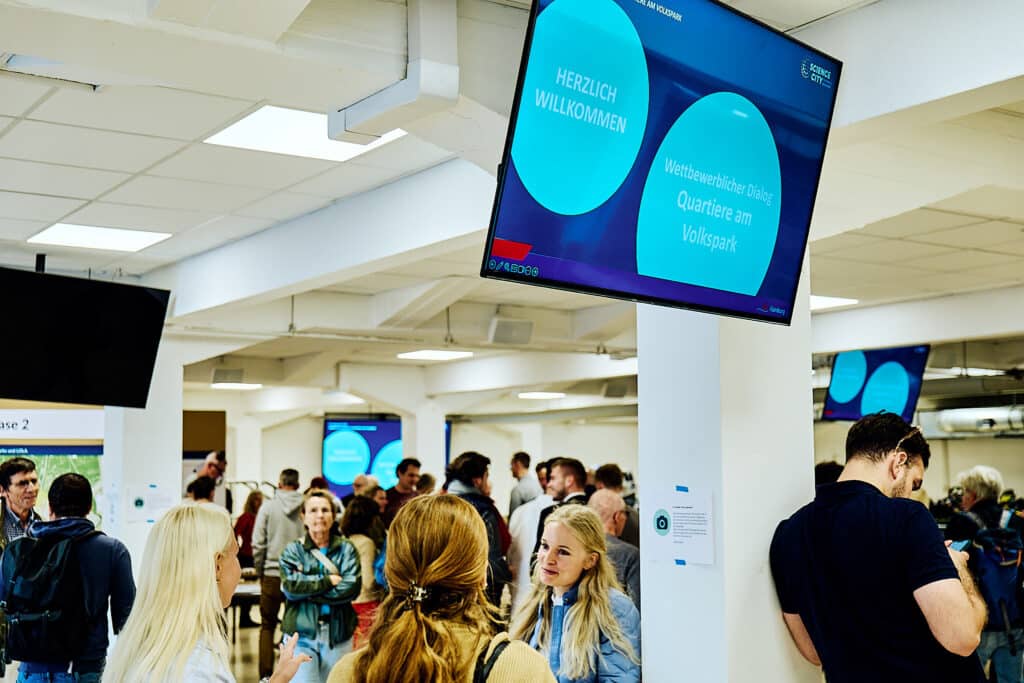
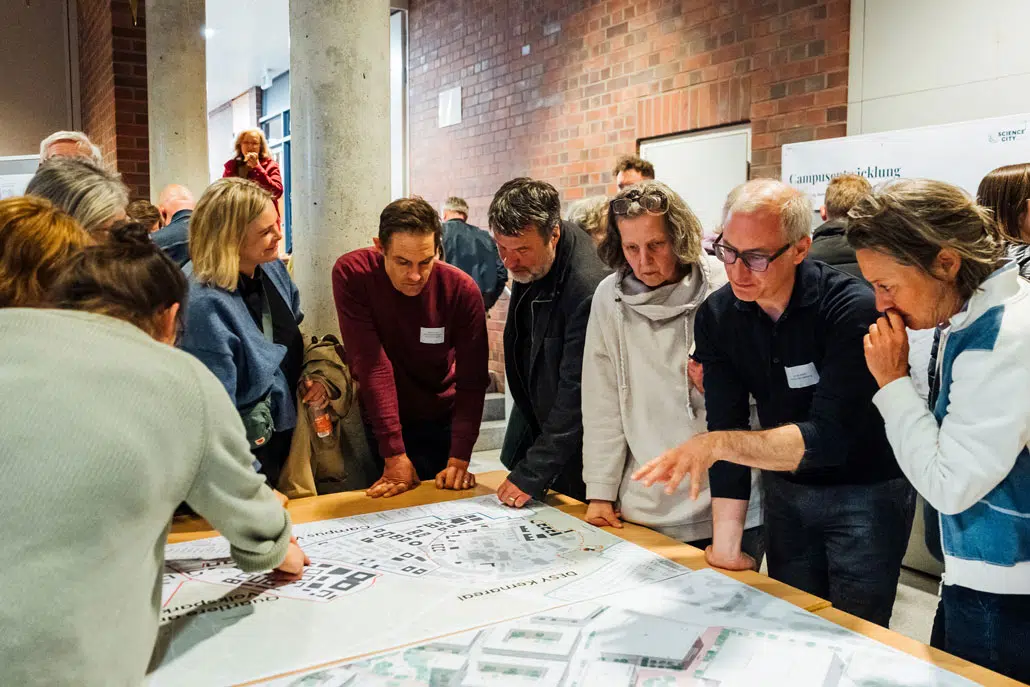
The invitation was particularly well-received this time, and the auditorium at the Esther Bejarano School in Bahrenfeld was packed: Around 120 interested attendees came on April 8, 2026, to the public forum on the status of functional planning for the neighborhoods near Volkspark. They took advantage of the opportunity for discussion, which was DESY by Science City Hamburg Bahrenfeld in collaboration with many project partners, such as the Ministry of Transportation and Mobility Transition, the Ministry of Science, Research, and Equality, the University of Hamburg, and DESY .

© Miguel Ferraz
The Olympics in Town
After a brief welcome and introduction, the evening began with a discussion of the Olympic bid, which Hamburg residents will vote on on May 31, 2026. If the city becomes the host of the Olympic Games in 2036, 2040, or 2044, the neighborhoods around Volkspark will become Volkspark Olympic and Paralympic Village and temporarily house around 15,000 athletes and their support staff. This temporary use fits perfectly with the long-term neighborhood development, explained Simone Blunck from the team for the preliminary project on the Olympic and Paralympic Games at the Department of the Interior and Sports. The requirements for the future neighborhoods—short distances, a dense network of pedestrian and bicycle paths, accessibility, and a high quality of life in public spaces—are also central goals for the Olympic and Paralympic Village. The athletes’ shared living spaces could subsequently be converted into regular apartments with little effort. “The Olympics are coming to Science City,” Blunck emphasized. Science City is scheduled to be completed by the late 2040s. This timeline also aligns with the bid’s schedule, added Melanie Parr of Science City Hamburg Bahrenfeld later during the Q&A session.

© Miguel Ferraz
Sports, Recreation, and Rainwater
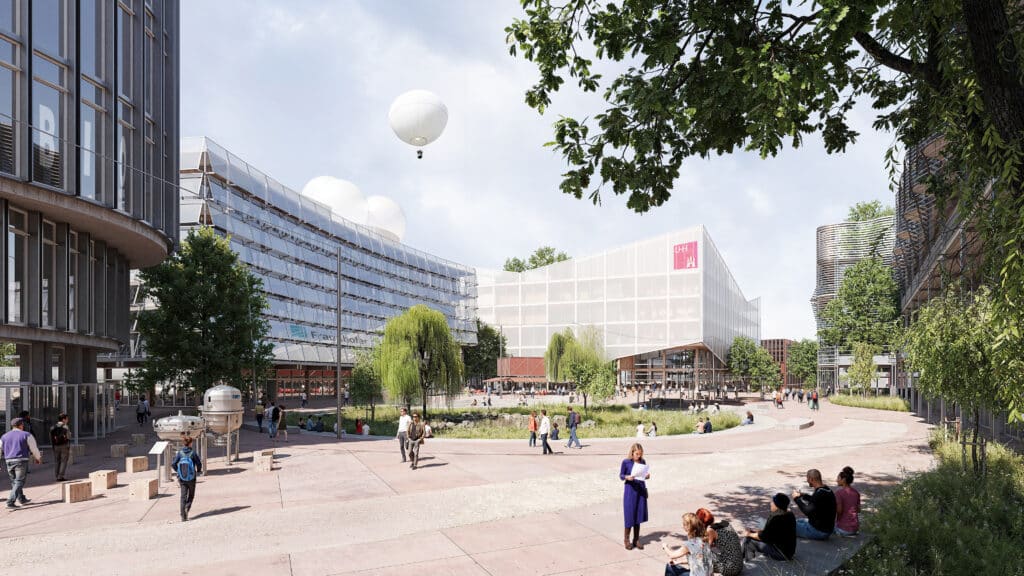
Even setting aside the Olympic spirit that might Science City Hamburg Bahrenfeld , sports are a key consideration in urban and open-space planning, reported Karoline Liedtke-Sørensen and Lene Zingenberg from the Danish architectural firm Cobe, who presented the current status of the functional planning. Among other things, there will be two soccer fields, as well as university sports facilities and a skate park. Activity and movement are woven throughout all the open spaces in the neighborhoods, where, according to current plans, around 4,500 apartments are being built—more than half of which are rental units in subsidized housing, but also include condominiums.
In particular, the “green corridor” connects the three sub-neighborhoods with one another, as well as with Volkspark Altona the other surrounding green spaces. It not only incorporates some of the sports facilities and attractive walking and biking paths, but also serves as a recreational area, provides green outdoor spaces for daycare centers, and, last but not least, absorbs rainwater. To this end, it is designed so that rainwater flows into drainage basins, ditches, and retention ponds.
The extensive network of walking and biking paths has also already been planned in detail. A total of four neighborhood parking garages are planned near the entrances to the neighborhood, where private cars can be parked. The apartments themselves are best reached on foot or by bike to foster a vibrant neighborhood where residents can meet, for example, on their way home. This model is already working very well in Copenhagen, reported the COBE urban planners. In addition to a commuter rail station in Campusviertel , bus stops Campusviertel the public transportation network. The main pathways within the neighborhoods are barrier-free.

© Miguel Ferraz
Questions about the Olympics and transportation
The subsequent Q&A session was well-attended. Topics included the planned Olympic Village Plaza, parts of which are set to be open to the public during the Olympic Games. Issues related to housing construction and accessibility also drew significant interest. Critical questions focused in particular on the expansion of public transportation connections. Many of the event participants engaged in direct conversation with project stakeholders at six different dialogue stations, discussing topics such as urban planning, open spaces, mobility, and the Olympics.
Text: Andrea Bittelmeyer